
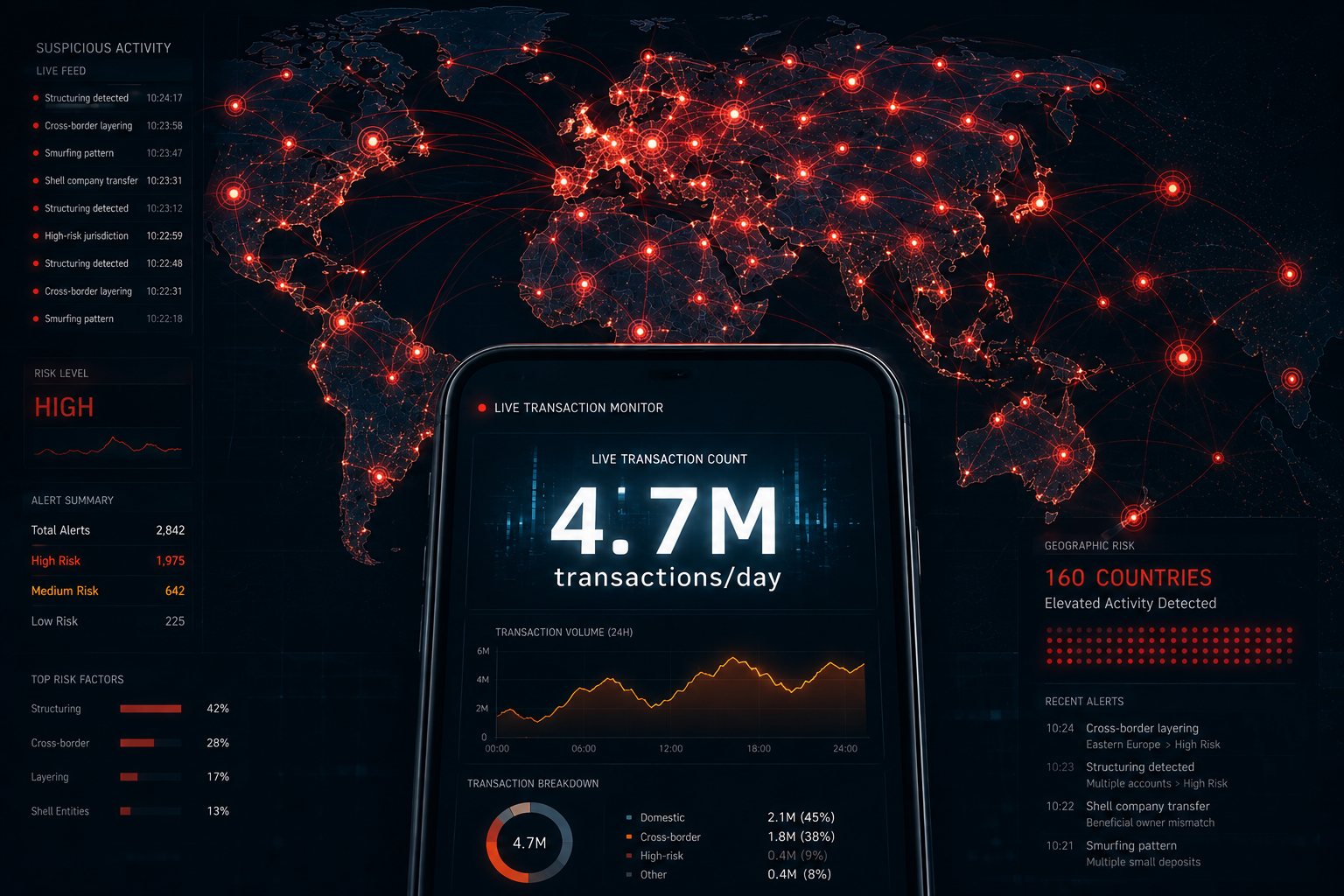
Wise processes 4.7 million transactions a day across more than 160 countries. Its AML controls for fintech payment platforms have now been questioned in three separate jurisdictions. The latest is Belgium, where prosecutors are finalizing a direct summons to criminal court over more than €500 million in suspicious transactions spanning 30 European countries.
On 1 June 2026, the Bureau of Investigative Journalism published a report revealing that Belgian prosecutors had opened a money laundering investigation into Wise Europe, the company's Brussels-based entity responsible for all European Economic Area operations. The Brussels Public Prosecutor's Office confirmed the investigation, stating it originated from the repeated appearance of Wise accounts in hundreds of criminal files received through European Investigation Orders and international letters rogatory. The transactions under scrutiny are linked to fraud, drug trafficking, and corruption.
Wise confirmed it is cooperating with prosecutors and stated that no specific findings have been shared with the company to date. The news sent Wise's share price down as much as 20% in early trading on the day of the report.
The investigation is at an advanced stage. Prosecutors say they are nearing completion and finalizing a direct summons before the criminal court. No charges have been filed and no findings have been formally communicated to Wise. But the pattern of regulatory scrutiny across three jurisdictions in quick succession raises compliance questions that go beyond this single investigation.
What the Investigation Is About
The Belgian investigation did not begin with a regulator examining Wise's books. It began with criminal files. Prosecutors at the Brussels Public Prosecutor's Office began seeing Wise accounts appear repeatedly across hundreds of cross-border law enforcement requests from more than 30 countries. The volume and pattern of those appearances triggered an investigation into whether Wise's AML controls for fintech payment platforms were adequate to detect and prevent its accounts being used to move illicit funds.
The transactions under review are linked to three categories of criminal activity: fraud, drug trafficking, and corruption. The total value exceeds €500 million. The investigation is being handled by DJSOC, Belgium's federal judicial police, and is described as being at an advanced stage with prosecutors preparing to move to the criminal court directly, a route that bypasses the need for an investigating judge and is the standard prosecutorial path in Belgium.
"The case originated from the repeated appearance of Wise in hundreds of criminal files received in Belgium, notably through European Investigation Orders and international letters rogatory."
Brussels Public Prosecutor's Office, June 2026
Wise has not admitted wrongdoing. In a stock exchange filing, the company acknowledged the investigation and stated it is cooperating fully. It noted that prosecutors' inquiries are still incomplete and that no specific findings have been shared. Wise also pointed to the scale of its compliance operation, stating that approximately a third of its global staff is dedicated to fighting financial crime.
This Is Not the First Time
The Belgian probe is the third jurisdiction to raise formal concerns about Wise's AML controls, and that pattern matters as much as any single investigation.
United States: $4.2 million BSA penalty, 2025.
Wise's US subsidiary was fined $4.2 million by regulators in six states following an investigation into violations of the Bank Secrecy Act and AML laws under the Countering the Financing of Terrorism programme. Regulators found that Wise US had not reviewed its compliance program independently or as often as required, and had mishandled the investigation and reporting of suspicious activity, including failing to file suspicious activity reports on time. Problems flagged in earlier examinations had not been promptly remediated.
United States: CFPB action, 2025.
The Consumer Financial Protection Bureau separately ordered Wise to pay approximately $450,000 to customers and a $44,955 penalty over deceptive marketing of ATM fees and violations of federal rules on electronic fund transfers. While not an AML action in the traditional sense, it added to a pattern of regulatory scrutiny of Wise's compliance practices in the US market during the same period.
Belgium: Criminal investigation, ongoing, 2026.
The Belgian investigation is the most serious in scope and potential consequence. A direct summons to criminal court, if filed, would represent a formal criminal proceeding rather than a regulatory enforcement action. The transactions involved exceed €500 million, span 30 countries, and are linked to fraud, drug trafficking, and corruption. Prosecutors say the investigation is nearing completion.
The Bigger Pattern
Wise is not the only fintech to find itself in this position. In 2025, fintech and crypto firms accounted for approximately 84% of the top ten AML and KYC-related fines globally, totalling around $1.1 billion. The structural reasons for this concentration are well understood. Cross-border payment platforms process high volumes of transactions at speed, often with a deliberately low-friction onboarding experience. That combination creates conditions that sophisticated bad actors are specifically designed to exploit.
The challenge is not that fintechs are indifferent to financial crime. Wise's own statement references a third of its global workforce dedicated to compliance. The challenge is that at the scale these platforms operate, even a well-resourced compliance function can struggle to maintain monitoring coverage that keeps pace with the transaction volume, the geographic spread, and the constantly evolving methods used to move illicit funds.
What the Belgian investigation describes, accounts appearing repeatedly in hundreds of criminal files across 30 countries, is precisely the type of pattern that continuous monitoring is designed to surface. The question is whether the monitoring was calibrated to detect it, and whether the alerts it generated were acted on in a way that met regulatory expectations.
What Fintech AML Compliance Needs to Look Like at Scale
The Wise case and the broader pattern of fintech enforcement actions point to four areas where compliance programs at high-volume payment platforms consistently face scrutiny:
Transaction monitoring calibrated for cross-border typologies, not just domestic thresholds. Monitoring rules designed for single-jurisdiction transaction behavior will not reliably detect suspicious patterns in cross-border payment flows. Thresholds, peer group logic, and alert rules need to reflect the actual behavior of the customer base being served, including the geographies, currencies, and transaction frequencies involved. A platform processing 4.7 million transactions a day across 160 countries requires monitoring logic of corresponding complexity.
SAR filing processes that are timely, documented, and independently reviewed. The US enforcement action against Wise specifically cited failure to file suspicious activity reports on time. Late or missed SAR filings are one of the most cited failures in AML enforcement actions across all institution types. For high-volume platforms, the volume of potential alerts makes SAR decision workflows particularly vulnerable to delays and inconsistency. Independent review of the SAR process, separate from the teams making the filing decisions, is a standard expectation in regulatory examinations.
Compliance program reviews that are independent, documented, and acted on. US regulators found that Wise had not reviewed its compliance program independently or as often as required, and had not promptly remediated problems identified in earlier examinations. A compliance program that is reviewed infrequently, or whose findings are not tracked through to remediation, provides less assurance than the review schedule alone might suggest. Independent testing, gap tracking, and documented remediation are what examiners look for when they ask whether a program is functioning.
Customer monitoring that identifies behavioral patterns across jurisdictions, not just individual transactions. The Belgian investigation originated from the repeated appearance of Wise accounts across hundreds of criminal files in multiple countries. That type of pattern, an account or customer appearing consistently in law enforcement requests across jurisdictions, is precisely what continuous customer monitoring is designed to surface. Point-in-time screening at onboarding is not sufficient to detect this kind of ongoing use of accounts for illicit purposes. Ongoing behavioral monitoring, updated as new information becomes available, is what closes that gap.
The Sentinel Perspective
The Wise investigation illustrates a compliance challenge that is specific to high-volume, cross-border payment platforms but relevant to any institution processing international transaction flows at scale. The issue is not whether the platform has a compliance program. It is whether that program is generating the right signals from the right data, and whether those signals are being acted on consistently across all the jurisdictions the platform operates in.
Sentinel's AML and KYC screening platform is built to support exactly this type of continuous, cross-border monitoring. Rather than relying on static onboarding checks, Sentinel monitors your customer base on an ongoing basis and generates alerts when transaction behavior, screening data, or risk indicators change in ways that warrant review. For payment platforms and financial institutions processing high volumes of cross-border flows, that continuous layer is what the difference between detection and enforcement action often comes down to.
The question the Belgian investigation is asking of Wise is the same question regulators will eventually ask of any institution operating at scale: when accounts in your platform were being used to move illicit funds, what did your monitoring see, and what did you do about it?
See How Sentinel Supports AML Compliance for High-Volume Payment and Fintech Platforms
Request a demonstration tailored to your institution's AML program and cross-border transaction risk profile.
Official References
- Money Transfer Giant Wise Investigated for Half a Billion in Suspicious Transactions — Bureau of Investigative Journalism, June 1, 2026
- Wise Faces Belgian Money Laundering Investigation — American Banker, June 2, 2026
- Wise Shares Plunge as It Faces AML Probe Over €500M in Suspicious Transactions — AML Intelligence, June 2026
- Belgium Investigates Wise Europe Over AML Controls — Yahoo Finance / Electronic Payments International, June 2026
Truth Technologies provides AML, KYC, OFAC, and sanctions screening compliance solutions through the Sentinel platform. This post is published for informational purposes only and does not constitute legal advice. The Wise investigation is ongoing. No charges have been filed and no findings have been formally communicated to Wise. All facts are sourced from publicly available reporting and official sources linked above.